Key Takeaways:
- SEC and CFTC Redefine Digital Asset Classification
- Nasdaq and ICE Push Tokenized Equities Into the Mainstream
- Race for Agentic Payments Infrastructure Intensifies

SEC and CFTC Redefine Digital Asset Classification
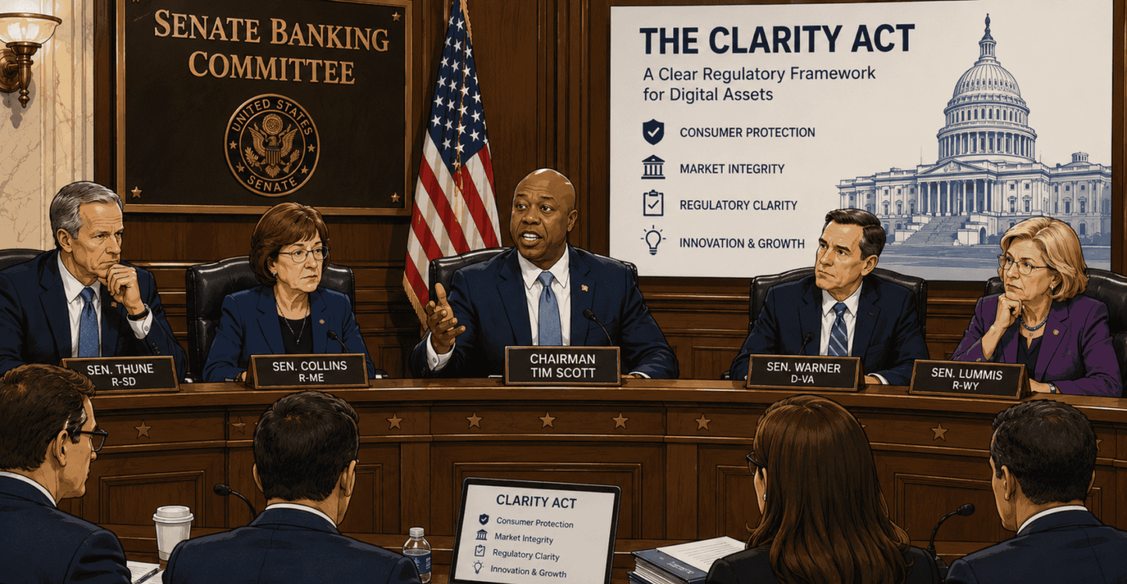
The SEC, alongside the CFTC, released landmark guidance formally categorizing digital assets into five buckets, including digital commodities, stablecoins, and digital securities. Crucially, only “digital securities” (i.e. tokenized versions of traditional financial instruments) fall under securities laws, while the majority of crypto assets are explicitly excluded.
This marks a major departure from the prior enforcement-driven approach, replacing ambiguity with a clearer – though still non-binding – framework. While issued as an interpretive rule (and therefore not legally binding), it provides the market with a clear signal of how regulators intend to treat crypto going forward, significantly reducing uncertainty for institutional participants across trading, custody, and issuance.
Nasdaq and ICE Push Tokenized Equities Into the Mainstream
Nasdaq is actively working with Payward (Kraken parent company) and issuers to bring tokenized equities to market, aiming to give companies greater control over share ownership, governance, and investor engagement through programmable features. This includes modernizing processes like proxy voting, corporate actions, and shareholder communication.
In parallel, Intercontinental Exchange (NYSE parent company) announced a similar initiative with OKX, alongside a strategic investment valuing the exchange at ~$25B.
These moves build on a broader wave of institutional activity – from DTCC and JPMorgan to BNY Mellon and Morgan Stanley – highlighting that tokenization is rapidly becoming a strategic priority across traditional finance. The implication is clear: public markets are beginning to adopt blockchain as underlying infrastructure, not just an adjacent asset class.
Race for Agentic Payments Infrastructure Intensifies
March saw a surge of activity around payments infrastructure for AI agents, with major players across crypto, fintech, and cloud competing to define the standard.
Stripe and Paradigm-backed Tempo launched a payments-focused blockchain alongside the Machine Payments Protocol (MPP), competing with Coinbase’s x402 standard. At the same time, AWS published integrations for agent payments, Visa launched tools enabling AI-driven card transactions, and Coinbase explored stablecoin infrastructure embedded at the internet layer via Cloudflare.
Two competing standards – MPP and x402, both built around HTTP 402 (“Payment Required”) – are emerging as core primitives, enabling machines to autonomously transact and verify payments. The takeaway: a new payments layer is being built for an agent-driven internet, with stablecoins and crypto rails at its foundation.

Polymarket Scales Monetization as ICE Doubles Down
Polymarket introduced a fee switch while securing an additional $600M investment from ICE, reinforcing its position as the leading on-chain prediction market. The fee switch represents a key transition toward sustainable revenue generation, following a period of rapid user and volume growth.
More importantly, ICE’s continued involvement signals growing institutional conviction in prediction markets as a financial primitive, particularly as a source of real-time, crowd-sourced data. As these platforms mature, they are increasingly being viewed not just as trading venues, but as information infrastructure with applications across finance, media, and risk management.
Disclaimer: this newsletter was put together for informational purposes only based on our review and analysis. This should not be construed as a solicitation, offer, or recommendation to acquire or dispose of any investment or engage in any transaction.